
The Cornell 7: The Legal Intoxication Exclusion
By: Daniela Cardona
Cornell 7: The Case
The Cornell 7: Jonathan Newell, Winston Lee, Gillio Lopes, Diego Sarabia, Scott Norris, Scott Kretzschmar, and Matthew Ingalls. Seven perpetrators. Seven men. Seven autonomous individuals.
One victim.
On September 16, 2026, a woman, identified only by a pseudonym, filed a civil lawsuit alleging that, on the night of 19 October 2024, seven men from Cornell's Chi Phi fraternity chapter assaulted her for seven hours in an incident involving alcohol, marijuana, and ketamine. She became completely incapacitated while frat members were sexually assaulting her, the lawsuit alleges.
Jane Doe was a 20-year-old Cornell undergraduate at the time. In her lawsuit, Doe claimed that, from the start of her encounter involving the seven fraternity members, she was incapable of consent because she was severely intoxicated.
She said she left her sorority sisters after drinking that night and "stumbled alone" to the Chi Phi fraternity house in the city of Ithaca to see a male friend. It was Matthew Ingalls whom Jane Doe originally went to visit at the Chi Phi fraternity house at about 11 p.m. She walked there alone from a bar to see him, with her intoxication level from drinking through the evening at about a 5 out of 10, she told investigators.
After she arrived, Mr. Ingalls asked her if she wanted to have a threesome with Jonathan Newell, Jane Doe said. During that encounter, it was reported that the men gave her ketamine and alcohol. Eventually, other men engaged in sexual acts with her without her consent and while she was incapacitated, she said.
The lawsuit alleges sexual assault and battery, negligence, breach of contract, and violations of New York's Human Rights Law. It was filed against several groups including the university, the Chi Phi fraternity, the Delta Delta Delta sorority, and the men involved in the alleged attack. Doe also alleges that the men were "afforded the opportunity to mitigate their conduct by submitting essays". Doe's lawyer has said she was "traumatised, numb and unable to function or accept the horror of what had happened" in the days after the assault, which she reported to Cornell University Police days after the alleged attack.
The university convened a closed proceeding to determine what had occurred and whether those men should face discipline. The punishments handed out by the three-member panel, which met on Zoom over 12 days in May 2025, varied widely. The panel, which enforces federal civil rights at the university under Title IX provisions, did not conclude that Jane Doe was sexually assaulted by all the men she had accused, according to the discipline summaries.
The most severe punishment was expulsion from the school, which two of the fraternity members received: Matthew Ingalls and Jonathan Newell. The men who sent a Snapchat message to a group chat of 57 fraternity members, encouraging them to enter the bedroom where Jane Doe was undressed, the discipline summaries show. Another, who had already graduated, was barred from campus. Two more were suspended. The remaining men were handed lighter punishments, the summaries of the punishments acquired by the New York Times show.
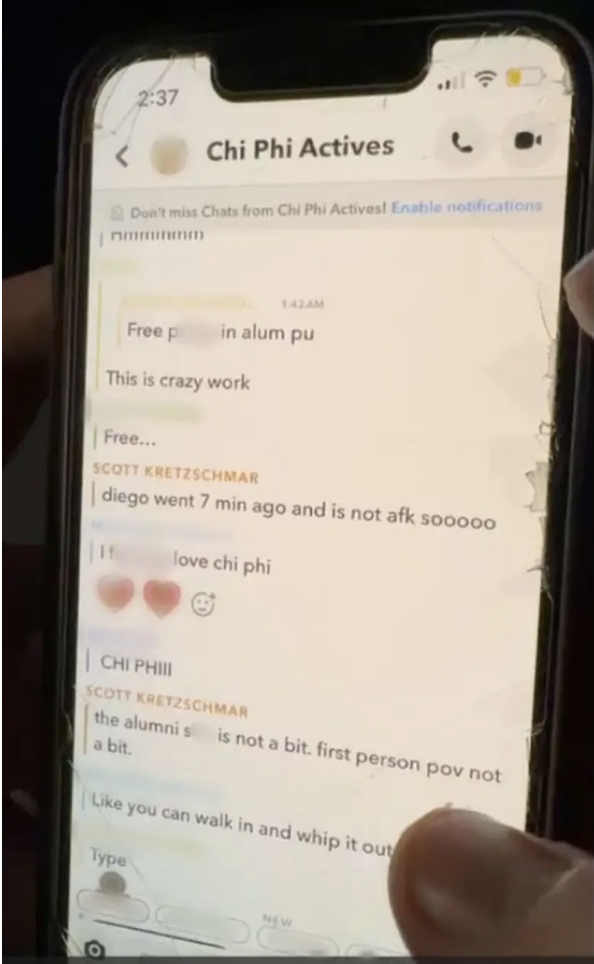
Snapchat messages included as exhibits in the civil lawsuit. (Civil lawsuit)
“Free pussy in alum pu”---Jonathan Newell
“I fucking love chi phi”---Mathew Ingalls
“Like you can walk in and whip it out”---Mathew Ingalls
The discipline summaries show that the panel found Mr. Ingalls responsible for sexual assault, judging that he was willing to manipulate, exploit, and endanger Jane Doe for his own self-interest and the entertainment of others.
Mr. Newell was also accused of sexual assault, the university files show. Jane Doe told police that he had struck her buttocks with enough force during intercourse to leave bruises, and that he had manipulated her to ingest ketamine.
Suspensions and disciplinary probation were given to Winston Lee and Gillio Lopes. Jane Doe had accused Mr. Lee of inhaling ketamine off her body and forcing oral sex on her. She alleged that Mr. Lopes had sex with her without her consent. Mr. Lee was suspended for two years, with several semesters of disciplinary probation upon his return; Mr. Lopes received a three-semester suspension and two years of probation, the discipline summaries show. Both men were also ordered not to contact Jane Doe and were required to study sexual harassment and to write reflection papers.
A persona non grata order (formal declaration permanently or temporarily banning an individual from campus grounds or properties due to trespassing, harassment, or policy breaches. Violators facing police trespass citations or arrest) was issued to Diego Sarabia, who had graduated by the time of the discipline panel’s ruling. Mr. Sarabia, whom Jane Doe accused of forcibly kissing her, was barred from campus for three years.
The remaining two men, Scott Norris and Scott Kretzschmar, were ordered not to contact Jane Doe, to study sexual harassment, social media use and bystander intervention, and to write “reflection papers.” They were accused of being part of a group of men who entered the room after reading Mr. Newell’s Snapchat message.
A recently unsealed lawsuit filed by Mr. Kretzschmar against Cornell shows that he was not found responsible for sexual assault. Instead, Cornell ruled that he had committed a lesser offense of attempted sexual exploitation. Jeremy Saland, a lawyer for Mr. Kretzschmar, said in a statement on Friday that the discipline his client received showed that he was “never accused of, nor found responsible for, rape.” “He was not even present during any sexual activity,” Mr. Saland said. All of them have denied any wrongdoing, and the Tompkins County district attorney declined to prosecute in 2024, with none of the men having been charged with a crime.
Jane Doe’s lawyer, Thomas Giuffra, said in a statement on Friday that the punishments “did not reflect the severity of the charges.” “With the exception of two of these men, all of them will be able to graduate with a Cornell diploma and live their lives reaping the benefits of this coveted degree,” Mr. Giuffra said. “In contrast, as of today, it is doubtful whether Ms. Doe will even graduate college or ever live a normal life due to what these men did to her.” The lawyer told CBS the accuser dropped out of university after the alleged assault.
Jane Doe's lawsuit contains an image purported to be from a fraternity group chat in which a participant alerted other members, in vulgar terms, to the potential for a sexual encounter with Doe. Cornell University said its police department provided an image of the Snapchat group, titled Chi Phi Actives, to prosecutors as evidence in November 2024. The members are named in the chat and discuss a "free" sexual encounter with Jane Doe, using coarse language, in the early hours of October 20, 2024.
CBS News New York has also published excerpts of additional text messages reportedly exchanged between one of the defendants and a woman who appears to be Jane Doe. The messages were reportedly sent two days after the alleged assault.
In one message, one of the men appeared to apologise for "how things went down". He said his memory was "kinda fuzzy", and that he and another man felt bad for being too intoxicated to "shut it down and kick people out before it got way out of hand". The woman in the text chain replied, saying her memory was "super clouded too" and that they were all intoxicated. She also wrote that "none of the sexual stuff was illegal" and that she liked being with him and another man. Doe suggested they smoke together again but leave out "the extra five billion men and ketamine".
Doe said she reported the incident to Cornell University Police two weeks after it happened.
Shortly afterwards, Cornell University issued a public statement regarding the allegations, which it called "serious and deeply disturbing". It said the campus police department was investigating and that it had suspended the local chapter of the Chi Phi fraternity, as well as "a number of students".
Cornell also said it had opened an internal investigation, as well as a civil rights inquiry under the Title IX law, which bars sex discrimination in schools that receive funding from the federal government, including most universities. Following the new lawsuit, the university disputed Doe's allegation that it did not adequately investigate or punish the alleged perpetrators. The university said the matter was referred to a "panel of trained faculty and staff" that issued "a range of sanctions, which included expulsions and suspensions from Cornell". Cornell did not deny the punishment for some of those involved, including writing an essay.
Tompkins County District Attorney Mathew Van Houten, the county's top prosecutor, said at the time of the alleged assault, his office concluded that evidence did not meet the legal bar to bring charges. Van Houten included a summary of what Doe told the Cornell University Police Department in 2024 after the alleged attack, noting it differed from the allegations laid out in the lawsuit. "Jane Doe's sworn statement in November of 2024 did not allege that she was drugged against her will or gang raped," Van Houten said in a statement on Monday. "On the contrary, Jane Doe's statement described her participation in drug use and sexual conduct as voluntary, conscious and consensual."
New reports have detailed what Doe reported to Cornell University's police following the incident. CBS News New York obtained a transcript of Doe's interviews with campus police that began on November 14 - more than three weeks after the incident. She tells police of the initial sexual encounter: "I was pretty OK with all of this." But the outlet reports that she said of what happened later: "I can say with 100% confidence I was raped."
The district attorney told CBS News he had never seen the transcript of the interview with campus police. Van Houten told the BBC he had only received a signed six-page summary of Jane Doe’s account written by a police officer from the alleged victim and a screenshot of the Snapchat messages. Based on that summary, Van Houten said he believed no crime had been committed, and that the woman's participation in drug use and sex was "voluntary, conscious and consensual."
Lawyer Thomas Giuffra said the six-page report omitted the woman telling investigators that she was confident of being raped, that she was subjected to physical violence, and that a fraternity brother had sent a message to a group chat using a vulgar term to advertise that a woman's body was freely available. The New York Times reported that a Cornell police investigator tried to get Van Houten's office to consider additional evidence in the weeks after the alleged rape, but was rebuffed.
The Tompkins County District Attorney concluded that no further investigation was necessary and asked the Cornell University Police Department to convey the non-prosecution decision to Jane Doe and never spoke directly to her or her attorney. Initially, Cornell University said it had shared "all investigatory information" with the district attorney's office. But it later changed its statement to say it had shared the accuser's statement and the Snapchat messages. The district attorney closed the case without having anyone interview the victim or anyone else involved in the alleged attack.
“In what world does the district attorney not even interview her, or anyone else involved, or even request the full transcript?” said Kath Hochul, current Governor of the state of New York. “This woman, this young woman, had already endured something that is utterly unspeakable. And then at every turn, she was failed by people and institutions with an obligation to protect her.”
In the wake of her lawsuit, Van Houten said he was reopening the investigation. Days later, Hochul ordered an independent review of Cornell’s handling of the case. On Thursday, October 1, she appointed the New York State attorney general, Letitia James, as a special prosecutor with the power to bring criminal charges. On Tuesday, October 6, Cornell trustees brought in former U.S. Deputy Attorney General Sally Yates to review how the school investigates sexual assault and sexual harassment, how the disciplinary process works, the campus police response, and more.
On October 13, Cornell University announced that it would be suspending parties and social gatherings at fraternity houses for the remainder of the academic year. In a letter to the Cornell community, the school’s president, Michael Kotlikoff, said that the ban on frat parties will “provide time for a thorough review of fraternity life at Cornell to determine whether and how it can safely continue” (The Guardian). Kotlikoff referred to the measure as an effort to “strengthen campus safety”.
“I have spent the past weeks listening to students, faculty, staff, parents, alumni, and trustees, who have shared their feelings of deep connection and sympathy with Jane Doe, anger and frustration that this could happen at Cornell, and outrage at the broader prevalence of sexual violence against women in our society. These conversations, and campus protests, have underscored my deep conviction that we must do better: that the time for meaningful and lasting change at Cornell, and at campuses across the country, is now.” (Letter to Cornell community by Michael Kotlikoff)
An Analysis on the “Voluntary Intoxication” Statute
"I felt like I was unable to make any decision because of how intoxicated I was," said Jane Doe, describing her state during one of the encounters on the night of October 19, 2024, in a police report obtained by ABC News.
The Cornell University case has brought intense public focus on New York’s “voluntary intoxication” statute, a legal loophole that severely restricts the prosecution of sexual assault when a victim has willingly consumed alcohol or drugs.
In a recent civil lawsuit filed on September 16, 2026, against seven men, Jane Doe stated she willingly drank alcohol before arriving at a fraternity house. Once inside, members led her upstairs, surrounded her, and pressured her to take ketamine, a dissociative anesthetic the Drug Enforcement Administration notes is frequently used to facilitate sexual assault. She alleges that multiple men then sexually assaulted her for hours.
Despite these allegations, Tompkins County District Attorney Methew Vo Houten initially declined to file criminal charges, citing state law regarding voluntary consumption. Van Houten noted that in her sworn statement to campus police, Jane Doe did not allege she was drugged against her will, physically forced into sex, or unconscious, stating, “The facts provided by Jane Doe’s statement do not allege that she was either rendered incapable of controlling her own conduct or that any drug was administered to her without her consent.” While public pressure has since forced the district attorney’s office to reopen the investigation, the case underscores systemic barriers survivors face when seeking justice.
The Legal Loophole: How New York Law Defines Consent
Under current New York Law, a person who voluntarily drinks or takes drugs is not legally considered “mentally incapacitated” during an assault, regardless of how intoxicated they become. The statutory definition dictates that a person is “mentally incapacitated” only if an intoxicating substance was administered to them without their consent, such as a spiked drink. If intoxication is voluntary, state law primarily recognizes lack of consent only if the victim was subjected to physical force or rendered “physically helpless,” meaning unconscious or entirely incapable of speech. Consequently, prosecutors cannot easily bring charges when a victim voluntarily consumed substances to the point where their ability to consent was compromised, provided they remain conscious and able to speak.
Jane Manning, director of the nonprofit Women’s Equal Justice, explained, “I see cases all the time where this is the conundrum, [where] she was so far gone that she only has partial memory, but can't prove that she was unconscious or incapable of speech. That’s the heart of the problem.”
Moreover, Lizzie Ahser, co-founder of Justice Without Exclusion, criticized how this distinction treats sexual violence differently from other offenses, noting, “For some reason, out of all the major crimes in [New York]. Rape is the only one that is treated differently, so the level of intoxication somehow eliminated the fact that a crime existed.” Critics argue that sexual assault is no less grievous when a victim has consumed drugs or alcohol, and that distinguishing between voluntary and involuntary intoxication improperly shifts the blame onto the victim’s choices rather than the perpetrator’s actions.
New York Sexual Assault Law in Context
New York is one of 19 states that distinguish between voluntary and involuntary intoxication when determining legal consent in sexual assault cases. Research by The Associated Press and a report published in The Journal of the American Academy of Psychiatry and the Law highlight how state victim impairment statutes fall into distinct categories nationally. Nineteen states, including New York, consider victims impaired or incapable of consent only if they were involuntarily intoxicated. Other states and the District of Columbia consider a victim incapable of consent due to incapacitation from either voluntary or involuntary intoxication, while some jurisdictions have no statutory text relating to mental impairment or lack an explicit statutory definition. Several states have recently reformed their codes, such as Minnesota, which explicitly amended its statutory definitions to include both voluntary and involuntary intoxication.
Map demonstrating four categories of felony criminal statutes relating to victim impairment or incapacity to consent to sexual contact or intercourse.
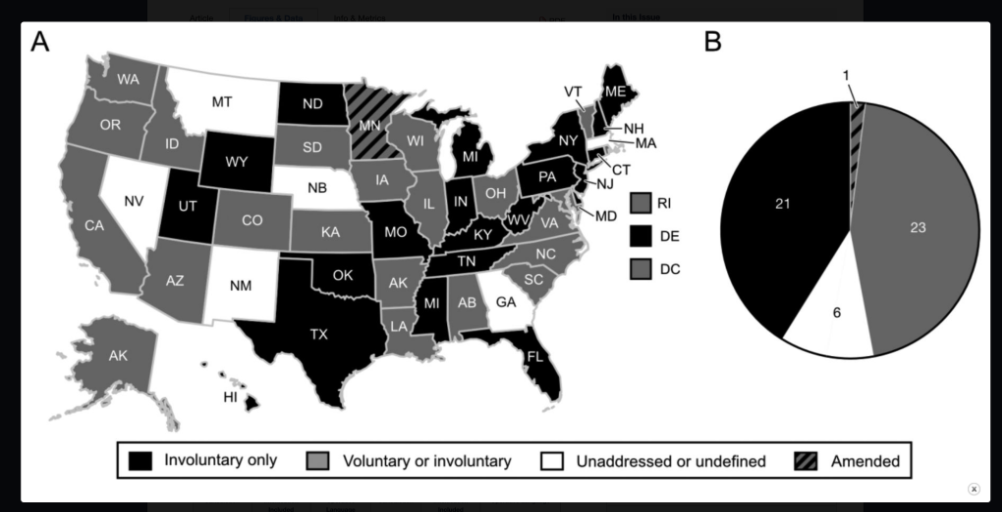
(Journal of the American Academy of Psychiatry and the Law)
Black denotes state statutes that only consider victims to be impaired or incapacitated if they are involuntarily intoxicated. Gray indicates states and the District of Columbia that consider a victim to be incapable of consent because of either voluntary or involuntary intoxication. White illustrates states that either have no statutory text relating to mental impairment or incapacity or do not include a statutory definition of mental incapacity. Finally, diagonal stripes show that Minnesota amended its definition of mental incapacity to include victims who are both involuntarily and voluntarily intoxicated.
Pie chart illustrating the number of jurisdictions falling into each of the categories listed.
New York’s rape statutes have undergone incremental reforms over the decades, though gaps remain. Prior to the 1970s, a victim’s testimony alone was insufficient for a rape conviction without physical corroborating evidence, a requirement not applied to crimes like robbery. Until 1982, victims were required to prove they actively fought back for an attack to legally qualify as rape. In the landmark 1984 decision People v. Liberta, the New York Court of Appeals struck down the marital rape exemption and gender-based distinctions in rape and sodomy statutes. The Sexual Assault Reform Act of 2000 later added the “No Means No” provision, establishing third-degree rape charges for forcible sex carried out despite clear refusal. The current “mentally incapacitated” language was drafted primarily in the 1990s to target cases where individuals were drugged without their knowledge, creating the current exclusion for voluntary substance use. More recently, the Rape is Rape Act of 2024 expanded the legal definition of rape to include all forms of nonconsensual forced penetration as well as nonpenetrative acts.
Within New York’s current legal framework, degrees of rape are determined by physical violence or helplessness, age, and legal capacity to consent. First-degree rape is a Class B violent felony carrying a sentence of 5 to 25 years, requiring proof of forcible compulsion and an unconscious or physically helpless victim. For specific age differentials where the victim is under 11, or 13 with an adult perpetrator 18 or older. Second-degree rape carries a sentence of 2 to 7 years and applies if the perpetrator is 18 or older with a victim under 15, or if the victim is incapable of consent due to mental disability or involuntary mental incapacitation. Third-Degree rape applies when a person forcibly engages in sex with someone who explicitly expresses a lack of consent under the “No Means No” provision.
The Push for Reform and Legislative Resistance
Legislation to eliminate New York’s voluntary intoxication has been introduced annually for at least eight years without passing the state legislature. Sponsored by Assemblyman Jeffery Dinowitz, who has introduced the measure every year since 2019, and State Senator Liz Krueger, whose related legislation extends rape-shield protections to civil proceedings, the proposed bill would classify nonconsensual sex with a mentally incapacitated person as third-degree rape, a Class E felony. This would close the loophole by making it a crime to engage in sexual acts with a person who is heavily under the influence and unable to control their conduct, regardless of how they became intoxicated. The bill does not criminalize sex under the influence generally, nor does it automatically classify all levels of voluntary drinking as inability to consent.
This reform aligns with a broader national momentum where several states have recently eliminated the voluntary intoxication defense. Minnesota revised its laws in 2021 after its state Supreme Court overturned a sexual misconduct conviction because the incapacitated victim had voluntarily consumed alcohol. Michigan made similar statutory revisions in 2023, and Texas followed in 2025 by passing the Summer Willis Act to redefine consent. Mental health and legal scholars strongly support this nationwide shift. Dr. Chinmoy Gulrajani, a psychiatry professor at the University of Minnesota who has researched state sexual assault laws, noted, “That business of whether the victim was voluntarily intoxicated or involuntarily intoxicated should really not matter in the vast majority of cases, if not all of them… The assailant should have known that this is not a person who is incapacitated, regardless of how they got there, and actually give that person protection.” New York Governor Kathy Hochul also expressed firm support for statutory change during a press conference, stating, “It should not matter whether they chose to use drugs or alcohol. Voluntary intoxication is not a license for sexual assault or gang rape. Period.”
Despite this support, legislative gridlock persists in Albany. While the New York State Senate has unanimously passed versions of the bill multiple times, including in June, the measure consistently stalls in the Assembly due to specific policy concerns raised by critics. The State Association of Criminal Defense Lawyers argues that the proposed definition of ‘mentally incapacitated’ is overly vague and should require outward physical signs of impairment. Yung-Mi Lee, former president of the association, emphasized that convicting a person of rape requires criminal intent, pointing out that the act of slipping drugs into a drink demonstrated clear intent, whereas gauging voluntary ‘drunkness’ is far more difficult. The State Association of Criminal Defense Lawyers also expresses concern that ambiguous standards make it difficult to determine the exact point of incapacity, potentially increasing false allegations and convictions that historically impact people of color and low-income individuals disproportionately.
Advocates stress that while updating the statute is critical, broader systemic issues must also be addressed. Activist Sarah Boylan observed, “Every step of the way, we have a system that penalises people for speaking up about their own harm. Changing legislation is incredibly important. But legislation in a lot of cases can only go so far as the paper that it's written on. It would be amiss to orient this horrible, tragic, unacceptable, infuriating case in isolation without looking at the broader rape culture of our state and our country.” Until statutory changes are enacted, survivors who voluntarily consume alcohol or drugs will continue to face steep legal hurdles within the justice system.
Ultimately, the statutory distinction between voluntary and involuntary intoxication remains an indefensible legal reality that fundamentally undermines the principles of justice, consent, and bodily autonomy. By prioritizing the precise mechanisms of how an intoxicating substance was ingested over the objective cognitive capacity of the victim at the time of the sexual act, existing legal statutes in nineteen states preserve an outdated framework that effectively shields perpetrators from criminal liability.
As demonstrated by the widespread institutional failures exposed by the ‘Cornell 7’ Lawsuit, this legal loophole does far more than complicate prosecution; it actively deters reporting, degrades evidentiary standards, and institutionalizes a system of legal victim-blaming that penalizes survivors for their preliminary choices. True legal reform requires a total shift. One that strips away assumptions about victim responsibility and instead shifts to center criminal sexual conduct laws on affirmative, capable consent. Although closing the involuntary intoxication loophole is imperative, it is essential to take active strides towards eliminating structural inequalities and place pressure on rape culture that continues to plague contemporary society every day.
Works Cited
Drenon, Brandon. “Defence Lawyer in Cornell University Case Calls for Special Prosecutor to Be Removed.” BBC, 6 Oct. 2026, www.bbc.com/news/articles/c9p8gxygvpg6o. Accessed 6 Oct. 2026.
Halpert, Madeline. “Drinking and Consent - Cornell Rape Allegations Expose ‘Loopholes’ in Laws.” Google.com, BBC News, 6 Oct. 2026, www.bbc.com/news/articles/c9e8l0ep8d1mo. Accessed 6 Oct. 2026.
“‘Is This Too Little, Too Late?’: Cornell Students on School’s Response to Gang-Rape Allegations.” The Guardian, Guardian News and Media, 17 Oct. 2026, www.theguardian.com/us-news/2026/oct/17/cornell-student-response-rape-allegations.
Lisa, Kate. “What to Know About New York’s Rape Laws - City & State New York.” Cityandstateny.Com, 5 Oct. 2026, www.cityandstateny.com/policy/2026/10/what-know-about-new-yorks-rape-laws/416417/?oref=csny-homepage-river. Accessed 5 Oct. 2026.
Mascarenhas, Lauren. “A ‘Loophole’ in New York’s Rape Law May Have Shut the Door on Criminal Charges in the Cornell Case. It’s Not the First Time.” CNN, 1 Oct. 2026, www.cnn.com/2026/10/01/us/ny-rape-law-loophole-cornell. Accessed 2 Oct. 2026.
Michael R. Sisak | The Associated Press, and Jennifer Vazquez. “Cornell Case Sheds Light on ‘Voluntary Intoxication’ Loophole in NY Rape Law. What Is It?” NBC New York, 2 Oct. 2026, www.nbcnewyork.com/news/local/cornell-case-sheds-light-on-voluntary-intoxication-loophole-in-ny-rape-law-what-is-it/6554972/. Accessed 2 Oct. 2026.
NBC New York. Gov. Hochul Updates Cornell Rape Investigation After Removing Local DA From Case. YouTube, 2026, www.youtube.com/watch?v=fQTSmI78LWc. Accessed 4 Oct. 2026, Video.
Nouhan, Catherine. “Cornell Case Puts New York’s Progressive Image at Odds With Its Rape Laws.” Al Jazeera, 4 Oct. 2026, www.aljazeera.com/news/2026/10/4/cornell-case-puts-new-yorks-progressive-image-at-odds-with-its-rape-laws. Accessed 4 Oct. 2026.
Teravskis, Peter J. “Victim Intoxication and Capacity to Consent in Sexual Assault Statutes Across the United States | Journal of the American Academy of Psychiatry and the Law.” Jaapl.Org, 2022, https://doi.org/10.29158/JAAPL.220032-21. Accessed 3 Oct. 2026.
The Associated Press. “Cornell Rape Allegations Lead to Renewed Scrutiny of Laws on Intoxication and Consent.” Audacy, 29 Sept. 2026, apnews.com/article/cornell-university-rape-allegation-intoxication-laws-b86e2cf18e301e83612c0a0dbdb0cb4b. Accessed 5 Oct. 2026.